
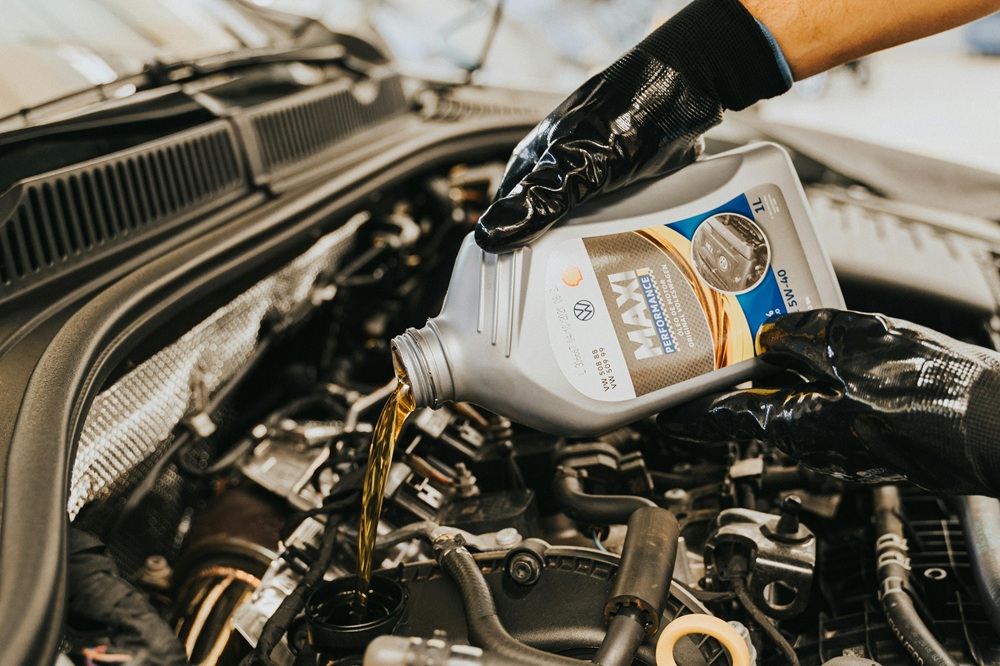
Engine oil is one of those things most drivers know they need but few actually understand. The label on the bottle — 5W-30, 10W-40, 0W-20 — might as well be a serial number for all the clarity it provides. Yet choosing the wrong oil, or running your engine on degraded oil past its service life, can cause real and expensive damage over time. As part of every car service in Cranbourne, our mechanics check oil condition, verify the correct specification for your vehicle and use only the right grade — because even a small mismatch in oil viscosity can affect your engine’s performance, fuel efficiency and long-term reliability.
This article explains what engine oil grades actually mean, why they matter for Australian driving conditions and how to find out exactly what your car needs — without having to decode a label.
What do the numbers on an oil label actually mean?
Engine oil viscosity — its resistance to flow — is described using a two-part number separated by the letter W, which stands for winter. The first number (before the W) describes how the oil behaves in cold temperatures. The lower this number, the more freely the oil flows when your engine is cold and first starting up. The second number (after the W) describes the oil’s viscosity at normal operating temperature — typically around 100 degrees Celsius.
Take 5W-30 as an example. The 5W tells you that the oil flows well at low temperatures, reaching the engine’s moving parts quickly at startup — which is when most engine wear actually occurs. The 30 tells you that at operating temperature, the oil maintains a specific thickness that provides adequate lubrication under load. A heavier grade like 15W-40 flows more slowly when cold, but offers greater film strength at high operating temperatures — which is why it is often preferred for diesel engines, commercial vehicles and older petrol engines.
The W rating became increasingly important as engine tolerances tightened over the decades. Modern engines are machined to much finer tolerances than vehicles from the 1980s and 1990s, and they are designed to function on lighter, lower-viscosity oils. Using a heavier oil than specified in a modern engine does not give you more protection — it actually increases internal resistance, forces the oil pump to work harder and can reduce fuel economy.
Why Australian driving conditions make oil specification even more important
Australia’s climate places specific demands on engine oil. In south-east Melbourne and across Victoria, drivers contend with cold winter mornings where temperatures can drop to single digits, and summer days where the mercury exceeds 40 degrees Celsius. This range of operating temperatures — combined with stop-start suburban driving, long highway runs and, for many south-east Melbourne drivers, regular towing or off-road use — means that oil selection is not a one-size-fits-all decision.
Cold-start protection is often underestimated. The vast majority of engine wear occurs in the first few seconds after startup, before oil pressure builds and the lubricant reaches all moving parts. An oil with a low cold-temperature rating — 0W or 5W — flows faster in those critical first moments and dramatically reduces metal-on-metal contact. Conversely, in high-temperature conditions or under heavy load, the oil must maintain sufficient viscosity to prevent the lubricant film from breaking down under pressure.
For 4WD and diesel vehicle owners — a significant proportion of drivers in south-east Melbourne — the demands are greater still. Diesel engines generate higher combustion pressures, run hotter and produce more soot and combustion by-products than equivalent petrol engines. They require oils that meet specific diesel engine standards (typically denoted by API ratings such as CJ-4 or CF) in addition to the correct viscosity grade.
Synthetic vs conventional vs semi-synthetic oil — what’s the actual difference?
Beyond viscosity grades, engine oil is also categorised by its base stock — the raw material from which the oil is manufactured. Conventional mineral oil is refined from crude petroleum and has been the standard for decades. Fully synthetic oil is chemically engineered to provide more consistent molecular structure, which translates to better performance across a wider temperature range, superior resistance to breakdown and longer service life. Semi-synthetic oil blends both base stocks, offering improved performance over conventional oil at a lower cost than full synthetic. When customers bring their vehicles in for an engine transmission service in Cranbourne, our mechanics specify the correct oil type based on the manufacturer’s requirements for that exact engine — not simply what is in stock or what costs less.
The shift toward fully synthetic oil in modern vehicles is not a marketing exercise. Manufacturers including Volkswagen, Mercedes-Benz, BMW, Toyota and Mazda specify full synthetic for most of their current engine ranges because modern engines are simply designed for it. The tighter tolerances, variable valve timing systems and turbocharged architectures of contemporary engines function optimally with the more consistent lubrication that synthetic oil provides. Using conventional mineral oil in an engine specified for full synthetic is not a cost-saving measure — it is a shortcut that accelerates wear.
Transmission oil is a separate consideration that is frequently overlooked. Manual and automatic gearboxes, as well as CVTs and dual-clutch transmissions like Volkswagen’s DSG, all require specific transmission fluids that differ from engine oil entirely. Automatic transmission fluid (ATF) is formulated to handle the heat and friction of hydraulic clutch packs. CVT fluid must handle the unique demands of a belt-and-pulley drive system. Using the wrong transmission fluid — or running a transmission past its fluid service interval — can result in slipping, shuddering and, ultimately, transmission failure.
How to find out what oil your car actually needs
The definitive source for your vehicle’s oil specification is the owner’s manual. Manufacturers list the required viscosity grade, oil standard (such as API SN or ACEA A3/B4) and, in some cases, the brand-approved specification (such as VW 504 00 or BMW Longlife-04). These specifications are not interchangeable — they reflect the specific chemistry required for that engine’s internal coatings, seals and operating parameters.
If your owner’s manual is lost, the same information is usually available on a sticker inside the engine bay, on the oil filler cap or through the manufacturer’s website. For older or imported vehicles where documentation is unavailable, a qualified mechanic can identify the correct specification using the vehicle’s VIN and current manufacturer data.
What you should avoid is simply buying the oil that is on special at the petrol station. Not all 5W-30 oils are the same — two products with identical viscosity ratings can differ significantly in their additive packages, oxidation resistance and compatibility with engine seals. Using an oil that meets the correct viscosity but does not carry the manufacturer’s approved specification can still void your warranty and cause internal damage over time.
How often should engine oil be changed?
Oil change intervals vary considerably by vehicle, oil type and driving conditions. As a general guide, conventional oil should be changed every 5,000 to 7,500 kilometres. Full synthetic oil, depending on the manufacturer’s specification, may be suitable for intervals of 10,000 to 15,000 kilometres. However, these are general parameters — your vehicle’s logbook specifies the precise interval for your make and model, and that is the figure that matters for warranty compliance.
Driving style also affects oil life. Short trips that do not allow the engine to fully warm up — common in suburban Cranbourne driving — are harder on oil than highway journeys. Stop-start traffic, towing, driving in dusty conditions and extended idling all accelerate oil degradation. If your driving pattern involves frequent short trips or demanding conditions, erring toward the shorter end of the service interval is the more protective choice.
Oil condition can also be assessed visually. Fresh oil is typically amber-coloured and translucent. As it ages and accumulates combustion by-products, it darkens and thickens. Milky or frothy oil is a warning sign of coolant contamination, which requires immediate investigation. Gritty or metallic-feeling oil indicates internal engine wear that needs professional assessment.
Let our qualified team take the guesswork out of oil selection
Understanding oil grades is useful, but you should not have to carry a specification chart every time your car is due for a service. Our mechanics in Cranbourne handle oil selection as a matter of professional process — we check your logbook, verify the manufacturer’s specification for your exact engine variant and use the correct oil grade and type on every service. There is no upselling to a more expensive product than your vehicle requires, and no downgrading to a cheaper option that saves us money at the expense of your engine.
Singh’s Tyre & Auto Centre is a Repco Authorised Service centre with over 15 years of experience servicing all makes and models — from everyday passenger cars and family SUVs through to diesel 4WDs, AWDs and commercial fleet vehicles. Every service is carried out to manufacturer specifications, using quality-approved parts and oils, and backed by the Repco Nationwide Warranty at over 500 locations across Australia. To book your next service or to ask our team what oil your car needs, call us on 03 8752 4599 or visit automobileservice.com.au. We are located in Cranbourne West and welcome drivers from across the City of Casey and south-east Melbourne.
Singh’s Tyre & Auto Centre uses the correct manufacturer-specified oil on every service — no guesswork, no shortcuts. Book your next service and let our qualified team look after your engine properly.
✆ Call us: 03 8752 4599 | 🌐 automobileservice.com.au