
Most drivers hand over their keys, head off to work or settle into the waiting lounge, and trust that the right things are being done to their vehicle. That trust is reasonable — but it should not have to be blind. At Singh’s Tyre & Auto Centre, we believe that transparency about what actually happens inside a workshop is one of the most powerful things a mechanic can offer. From the moment your car arrives to the moment you drive it away, there is a structured, methodical process happening on the workshop floor. Whether your vehicle is booked in for a routine logbook service, a mechanical repair, a tyre fitting or the work of our auto electrician in Cranbourne diagnosing an electrical fault, that process is the same — careful, documented and carried out with your approval at every stage. This article walks you through exactly what that process looks like, step by step.
Understanding what happens during a car service does not just satisfy curiosity — it helps you ask better questions, evaluate the service you are receiving and build the kind of informed relationship with your mechanic that saves you money and stress over the long term.
The moment you arrive — reception and vehicle check-in
When you pull into our Cranbourne West workshop, the first thing you will notice is that our reception area has a direct sightline to the workshop floor. That is not accidental. We want every customer to see the space where their vehicle will be worked on before they hand over the keys, and we want our team to know that the work they do is visible from the front desk. Accountability starts with visibility.
At check-in, one of our team members will sit with you to confirm the details of your booking — the service type, any specific concerns you have raised, the vehicle’s current odometer reading and the expected timeframe. If you mentioned a noise, a warning light or a change in how the car is handling when you booked, we pull up those notes and make sure the mechanic assigned to your vehicle is briefed on exactly what you described. We do not start fresh with every visit and ask you to repeat yourself. The notes are there, and they are used.
We also carry out a brief walk-around of your vehicle with you before you leave. Any existing marks, scratches or damage to the bodywork are noted. This is standard practice — it protects you and it protects us, and it means there is no ambiguity about the condition of the vehicle when it arrived. The walk-around takes two minutes and eliminates a significant source of potential misunderstanding.
The pre-service diagnostic scan — what we check before we open the bonnet
Before any mechanical work begins, your vehicle is connected to our professional-grade diagnostic scanner. Modern vehicles communicate through a network of electronic control modules — the engine management system, the transmission control module, the ABS module, the airbag system, the body control module and more. Each of these modules logs fault codes when a sensor reading falls outside the manufacturer’s acceptable parameters, and many of these codes will not produce a visible warning light until the fault is confirmed across multiple drive cycles.
The pre-service scan is one of the most valuable steps in the entire service process, and it is one that many workshops skip entirely. By reading the full fault code history before any work begins, we gain a complete picture of what the vehicle’s electronics have been recording — not just what the driver has noticed. A scan that reveals a marginal oxygen sensor reading, a developing ABS fault or an early transmission code allows us to address those items proactively, before they produce symptoms that are more disruptive and more expensive to resolve.
The scan results are reviewed by the assigned mechanic before they begin the service checklist. Any codes that fall outside the scope of the original booking are flagged, recorded and discussed with you before any additional work is quoted or authorised.
On the hoist — what the mechanic is actually doing
Once the pre-service scan is complete, your vehicle is raised on the hoist and the systematic service process begins. A logbook service follows the manufacturer’s prescribed checklist for your specific make, model and current service interval — not a generic multi-vehicle template. The checklist for a Mazda 3 at its 60,000 kilometre service is different from the checklist for a Toyota HiLux at the same interval, and our mechanics work from the correct document for your vehicle every time.
The engine oil is drained and the oil filter is replaced before the new oil is added. The oil specification used is the grade and type prescribed by your vehicle’s manufacturer — not a generic product that happens to be in stock. The correct oil for a turbocharged petrol engine is different from the correct oil for a diesel, and the correct grade for a SKYACTIV Mazda engine is different again from the specification for a European BMW or Volkswagen. This is one of the areas where the difference between a quality workshop and a transactional one shows most clearly.
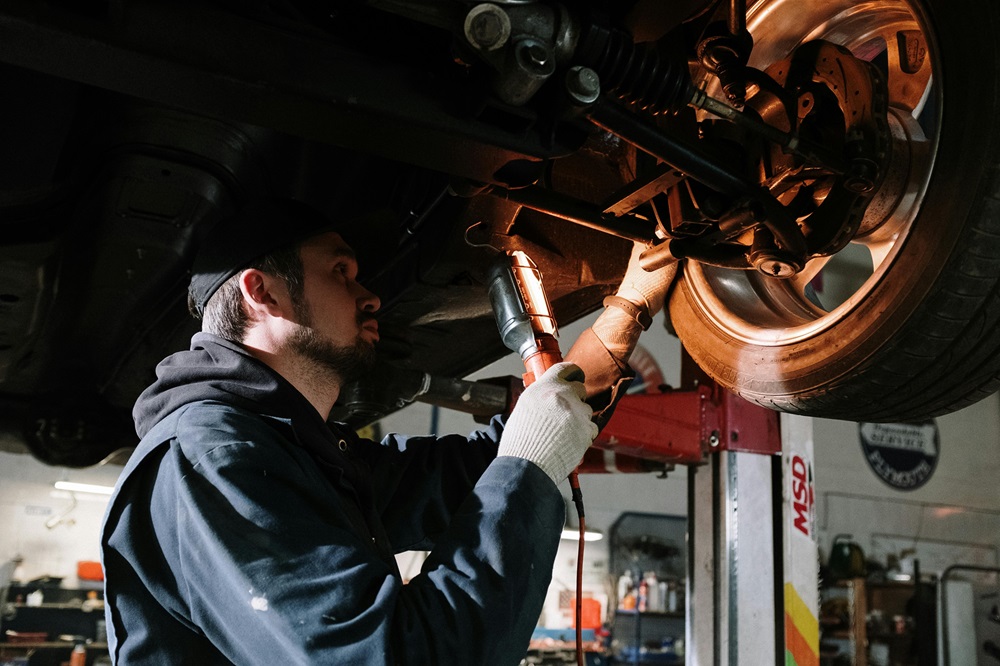
With the vehicle on the hoist, the mechanic has access to components that are invisible from above the engine bay. The brake lines, fuel lines, exhaust system, underbody structural members, suspension arms, CV boots, shock absorber condition and tyre sidewalls are all inspected from underneath. This undercarriage inspection is part of every service and frequently reveals items that the driver has no way of detecting from inside the vehicle — a developing exhaust leak, a cracked CV boot, corrosion on a brake line or a suspension component that is approaching the end of its service life.
Tyre tread depth is measured on all four tyres using a calibrated gauge, and tyre pressure is checked and adjusted to the manufacturer’s specified cold inflation pressure. Tyre age is also noted from the DOT date code on the sidewall — an item that is particularly relevant for vehicles where the tyres have low tread wear but significant age, as rubber degrades from the inside out regardless of how much tread remains visible.
Fluids, filters and the systems most drivers never think about
Beyond the oil service, a complete logbook service covers a range of fluid checks and replacements that are easy to overlook but genuinely important for the long-term health of the vehicle. Coolant condition and concentration are tested — coolant does not simply evaporate, but its corrosion inhibitors deplete over time and need to be replenished through a coolant flush at the manufacturer’s recommended interval. Brake fluid is tested for moisture content using a dedicated tester, as absorbed moisture lowers brake fluid’s boiling point and compromises performance under sustained heavy braking.
Power steering fluid, windscreen washer fluid and battery electrolyte levels are checked and corrected. The battery itself is tested under load using a battery analyser, which measures the battery’s actual cranking capacity against its rated capacity — a test that reveals a battery that is holding a surface charge but will fail under the demand of a cold-weather cold start. This test is one of the most practically valuable items in a thorough service and one that prevents the overwhelming majority of unexpected flat battery events.
The air filter is inspected and replaced if it has reached its service interval or is visibly contaminated. On vehicles with a cabin air filter — also called a pollen filter — this is also inspected and replaced as required. The cabin filter is one of the most frequently deferred maintenance items we encounter. A heavily contaminated cabin filter reduces airflow through the heating and air conditioning system, increases the load on the blower motor and degrades the air quality inside the vehicle — consequences that are invisible until the filter is removed and its condition is seen directly.
If we find something beyond your booking — what happens next
This is the moment that defines whether a workshop genuinely operates with integrity or simply talks about it. At Singh’s Tyre & Auto Centre, the process is unambiguous: nothing beyond your original booking proceeds without your explicit approval. If the mechanic identifies an item that needs attention — a brake pad at the wear limit, a tyre approaching its legal minimum tread depth, a coolant hose that is beginning to soften, a CV boot that is cracked and leaking grease — the item is documented with a description of what was found and why it matters, and we contact you directly.
We explain the finding in plain language — not technical jargon designed to create anxiety — and we tell you honestly whether it needs attention now, whether it can wait until your next scheduled service, or whether it should be monitored and reassessed at your next visit. We then quote the work before it proceeds. You hear the price before any additional parts are ordered or any additional labour begins. You decide. That sequence — find, explain, quote, receive approval, then proceed — is the only acceptable sequence, and it applies without exception.
The post-service scan and quality check
When the mechanical work is complete, your vehicle is lowered from the hoist and a post-service diagnostic scan is carried out. This confirms that no new fault codes have been introduced during the service and that any pre-existing codes identified in the pre-service scan have been addressed. The logbook is stamped and updated with the service date, odometer reading and items completed. A full service record is retained at our workshop.
The final quality check is carried out by the responsible mechanic against the manufacturer’s service checklist — not a general review, but a line-by-line confirmation that every prescribed task has been completed to the required standard. Only after this check is your vehicle signed off as ready for collection.
This is the standard every car service should meet — and what we deliver every time
The process described in this article is not reserved for premium vehicles or high-value customers. It is the standard we apply to every vehicle that comes through our doors, regardless of make, model or age. Our mechanics in Cranbourne are qualified, continuously trained through the Repco Auto Tech program and experienced across all makes and models — from everyday commuter cars and family SUVs through to diesel 4WDs, European vehicles and the full range of Japanese and Korean models that make up the majority of City of Casey driveways. Every service is performed to manufacturer specifications, every additional item is quoted before it proceeds and every vehicle leaves our workshop with a complete, honest record of what was done.
Singh’s Tyre & Auto Centre is located at 1/12 Universal Way, Cranbourne West VIC 3977 — a family-owned Repco Authorised Service centre with over 15 years of experience. Our work is backed by the Repco Nationwide Warranty at over 500 locations across Australia. We welcome drivers from Cranbourne West, Cranbourne, Clyde, Clyde North, Cranbourne North, Cranbourne East, Cranbourne South, Berwick, Narre Warren, Narre Warren South, Botanic Ridge, Lynbrook, Lyndhurst, Hampton Park, Hallam, Doveton, Endeavour Hills, Keysborough, Noble Park, Springvale, Springvale South, Dandenong, Dandenong South, Skye , Sandhurst and Eumemmerring. To book your next service or speak to our team, call 03 8752 4599 or visit automobileservice.com.au. Come and see the difference a transparent, honest workshop makes.